
BOWWBLOG #48: When Exhaustion Meets Enlightenment: A Week of Surfing, Crashing, and Coming Home to Stillness
How breaking my own rules taught me that presence is not about avoiding waves—it’s about learning to ride them without drowning
WHAT: The Week I Forgot My Own Medicine

This has been an unusually busy week. Seven to eight back‑to‑back meetings daily. By Friday afternoon, I was simply exhausted.
I take full responsibility. I broke my own rules. I let external demands impinge on my time until I felt completely out of whack. Bessel van der Kolk was right: the body keeps the score. And my body was writing a very loud report.
Here’s the thing: I was not mindless. I was intentional in setting my schedule. I could have pushed meetings to later dates, but I allowed myself to be dragged by the current of urgency. I went for volume—the sheer number of tasks done in the least time possible. It was a near‑safe‑to‑fail experiment, testing my breaking point.
With deep awareness, I watched myself surf from one wave to another… until I physically crashed.
The result? I had to rely on caffeine to enjoy a Michael Jackson biopic with my family. My presence at work and at home suffered. The joy of what I was doing drained away. All because I clung to efficiency like a lifeline.
SO WHAT: The Sacred Dance of Change—And Why I Keep Returning to It
What amazed me, though, was the openness of my heart in accepting reality exactly as it was. Anicca—everything changes. Everything that begins ends. And where there are endings, new beginnings always follow.
But I must admit: there was craving. Clinging to being efficient. That clinging is addictive, self‑reinforcing, until I realize I am caught in a vortex again.
So this week, I reminded myself of a simple practice that weaves together the wisdom of many traditions:
· Buddhism calls it anicca—impermanence as the door to freedom. You don’t resist change; you sit with it. Ajahn Chah taught: At all times, impermanence rules. This is the only thing that is permanent. Suffering comes not from change itself, but from grasping what is fleeting.
· Christianity invites transformation: Do not be conformed to this world, but be transformed by the renewing of your mind (Romans 12:2). In the chaos, God is doing a new thing (Isaiah 43:19). The anchor is Love that holds all things.
· Taoism offers wu wei—effortless action. Like water flowing around a rock, we find the path of least resistance. Do your work, then step back, says Lao Tzu. The only path to serenity.
· Islam teaches tawakkul—trust in the Divine Decree. Strive with your hands, rest your heart in Providence. One strives not because success is guaranteed, but because striving itself is an act of faith.
All these traditions agree: We do not escape change. We learn to dance with it.
And the first step of that dance is the STOP practice:
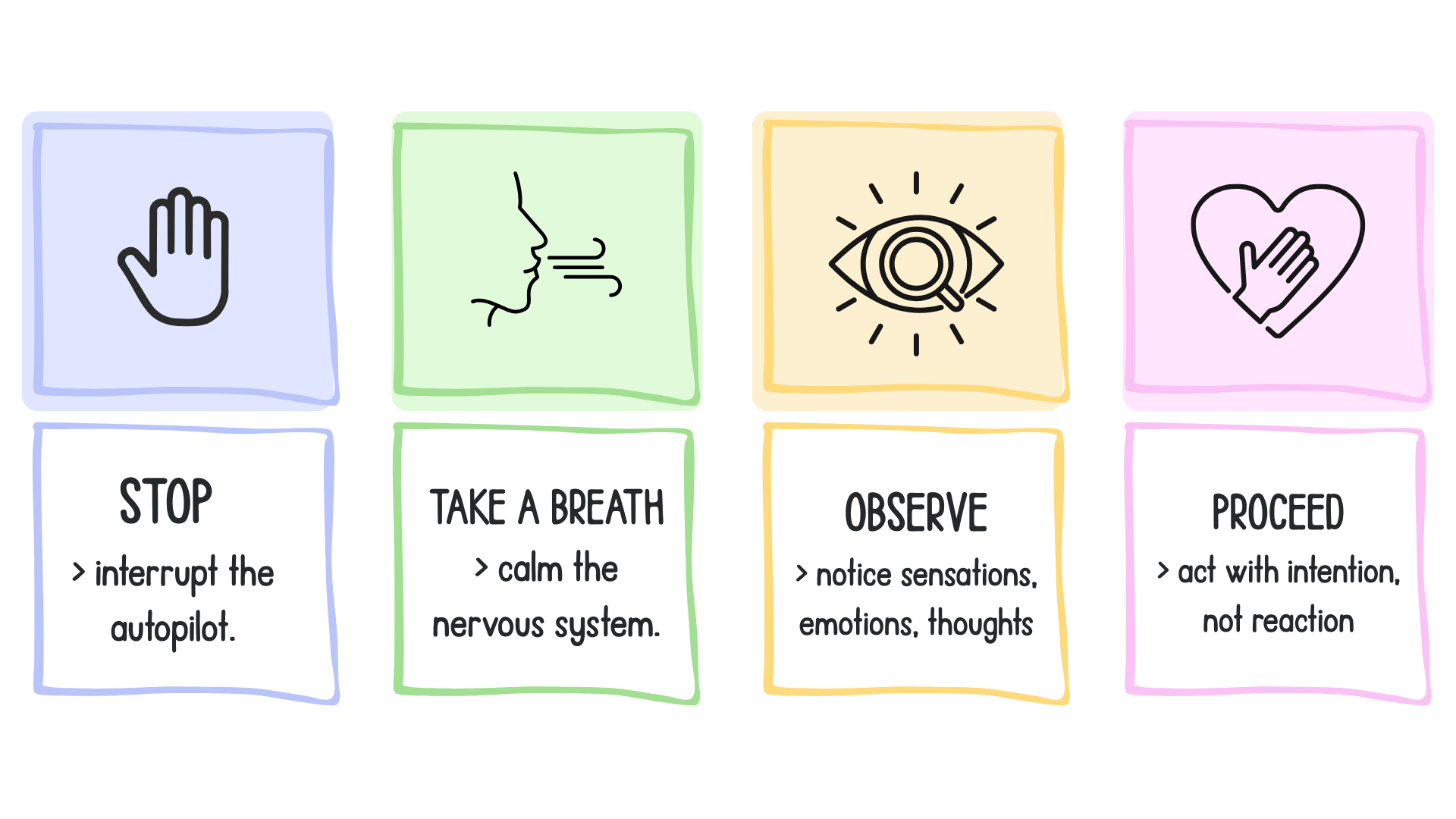
When I catch myself being carried away by the vortex, I practice STOP. It brings me back to the only moment that ever exists: now.
NOW WHAT: How to Ride Your Own Waves Without Drowning
You do not need a spiritual tradition to benefit from this. You only need a willingness to pause.
Here is a simple, do‑able practice for weeks when the waves feel too high:
1. The “Wave Audit” (5 minutes, weekly)
· Look at your calendar. Identify which meetings or tasks were truly essential and which you accepted out of habit, fear, or the craving for volume.
· Ask: What could I have said no to? What could I have postponed? No judgment—just data.
2. The “STOP Before the Crash” (daily, especially on busy days)
· Set a random alarm for midday. When it rings, physically stop. Take one conscious breath. Observe how your body feels—tight shoulders? Shallow breath? Empty stomach?
· Then ask: What is the most important thing for me to do right now? Not the most urgent—the most important for your wellbeing.
3. The “One Wave at a Time” Rule (real‑time)
· When you feel the pull to multitask or rush, whisper to yourself: I am surfing only one wave. Focus on the single task in front of you. Let the others wait.
· Why: Multiplicity is the enemy of presence. Monotasking is a form of self‑compassion.
4. Find Your “COMP” (Community of Mindful Practice)
· After my crash on Friday afternoon, I attended the inaugural session of our refreshed Community of Mindful Practices (COMP) —a small, intimate group of 12. Their collective energy was so refreshing that after the group sit, I felt energized enough to go another week.
· Action: Find or form a small group of kindred souls who sit together in silence—even virtually. Share your struggles with balance. Witness each other’s humanity.
· Why: Community holds us when our own willpower fails. It reminds us we are not alone in the vortex.
5. The “Never Again… But When I Do, I STOP” Promise
· I know I will break my own rules again. The craving for efficiency is deeply conditioned. But instead of “never again,” I now promise: When I notice I am being carried away, I will practice STOP.
· Write that promise down. Put it where you will see it mid‑crisis—your desk, your phone wallpaper, your journal.

The week was grueling. But the dénouement—the COMP session—was a gift. It reminded me that exhaustion is not failure; it is data. And data is the beginning of wisdom.
May you dance with your own waves this week—not perfectly, but presently.
-Susan Grace Rivera
Posted On: April 26, 2026