
WOWWBLOG #55: The Scalpel and the Stillness: What Three Days of Silence Taught Me About Freedom
An old student returns to the cushion—and discovers that the path out of suffering is not escape, but clear seeing
WHAT: The Call to Return
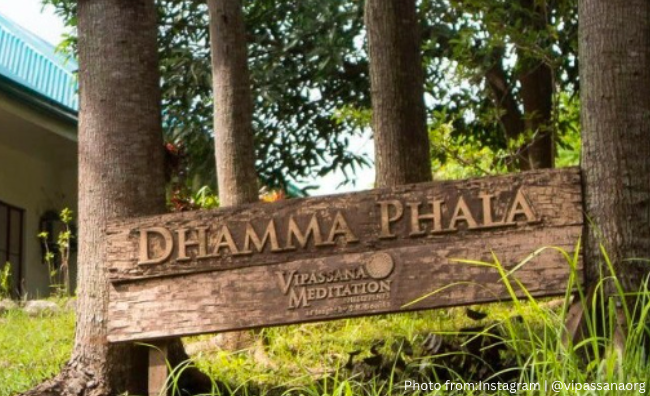
Last week, I attended a three-day refresher course for "old students" at the Dhamma Phala Center in Tiaong, Quezon . Twelve women, seven men. I am quite sure I was the eldest in the room. Eight servers tended to our basic needs—cooking, cleaning, holding the container so we could simply sit.
It had been 6 or so months since my last 10-day course where I served fulltime. I practice daily at home—twice a day, without fail. But nothing replaces the energy of sitting in silence with kindred humans who have developed an affinity for this ancient technique.
And within the wooded area of Tiaong where I felt I was at the very womb of nature.
We surrendered everything upon arrival. iPhone. Apple Watch. Wallet. Keys. All of it locked away. Then, a light vegetarian meal. An orientation. The five precepts. A commitment to noble silence.
Our days began with a gong at 4:00 AM. Meditation from 4:30 AM until 9:00 PM, with breaks for breakfast at 6:30, lunch at 11:00, and tea in the early evening. No dinner. No speech. No eye contact. No reading or writing. Just sitting. Walking to and from sleeping quarters. Sitting again.
I did not have the chance to meet everyone on "Day Zero." But I could sense that we lead very different lives—and yet, we are all the same. We all suffer. Either from frustrated cravings for things we desperately want but cannot reach. Or from clinging to pleasant successes, wrapping our identities so tightly around them that we cannot let go. Or from aversions—anger, ill will, helplessness—at what we see happening in our country, feeling we have absolutely no control.
The vicious cycle continues. The drama of victim, perpetrator, rescuer. The Karpman triangle, playing out in our minds, our families, our nation.
One young participant shared: "I attended my first ten-day course in April. I felt I wanted to return as a server." Another said: "How can we change our circumstances? Are we doomed to live this miserable life?"
A woman who now lives in Europe had flown back to reset and reconnect before returning. "Life," she said quietly, "should not just be about making money."
SO WHAT: The Threefold Training That Asks Nothing of Your Beliefs
The technique we practiced is called Vipassana—a Pali word meaning "to see things as they really are." Not as we assume them to be. Not as we wish them to be. Just as they are.
It is structured around three trainings:
· Sīla — ethical conduct. Not harming others through action or speech. In the course, this means observing five precepts, including noble silence. It is the foundation.
· Samādhi — concentration. Training the mind to focus. For us, this began with Anapana: attention on the breath, the small area just below the nostrils and above the upper lip. The whole cycle. Beginning to end. No visualization. No mantra. Just the raw sensation of air passing.
· Paññā — wisdom. Not intellectual knowledge, but direct, experiential understanding. This is Vipassana proper: using the sharpened awareness to observe sensations throughout the body, from the crown of the head to the tips of the toes. "Piece by piece, part by part," as the teacher would say.
Here is what I need you to understand: This is not about converting to any religion. I have practiced Centering Prayer for decades. I sit Zazen. I chant Metta. I am also a Catholic. None of this has ever been a contradiction.
As S.N. Goenka, the principal teacher of this tradition, once said at the United Nations:
"If there is no peace in the mind of the individual, I can't understand how there can be real peace in the human world."
And again, in another discourse, he emphasized:
"This is the beauty of the Buddha's teaching... If we make a sect out of it, difficulty arises. But when you take the essence—sīla, samādhi, paññā—everyone is bound to accept it because it is so scientific."
The Buddha did not teach a religion. He taught a method. A technology of the mind. It asks nothing of your beliefs. Only your willingness to observe.
The teacher who brought this technique to the West in its pure form was Sayagyi U Ba Khin (1899-1971) . He was not a monk. He was a married householder, a senior civil servant in Burma, the head of three government departments simultaneously. He founded the Vipassana Association in his accounting office and later the International Meditation Centre in Rangoon . His life was proof that deep inner work is possible amid deadlines, meetings, and family responsibilities. Goenkaji was his student.
The Historian Who Sits Two Hours a Day
I find myself turning more and more to the words of Yuval Noah Harari, the historian who wrote Sapiens. He is not a guru or a mystic. He is a professor who has practiced Vipassana for 24 years—two hours every day, plus long retreats in India.
When asked why he meditates, Harari said:
"For me, the key question of meditation is: what is reality? The mind is constantly producing fictional stories, imaginations, and they come between us and reality. Humans almost never encounter reality—only the fictions produced by their minds... We do not react to reality. We react to the fictions."
He calls meditation the practice of distinguishing fiction from fact:

He calls meditation the practice of distinguishing fiction from fact:
"When you close your eyes and sit down, the question that keeps repeating is: what is really happening right now? It starts with the simplest exercise: feeling your breath coming in and out of your nostrils. That is reality. And you just observe reality."
Most of us, he notes, can meditate for five or ten seconds before a fantasy hijacks our attention. Then we spend the next five minutes rolling in some story about the past or the future, until we realize we have drifted—and we return to the breath.
"If I cannot observe the reality of my breath," Harari says, "what hold do I have for understanding any reality at all?"
This is not esoteric. It is utterly practical.
My Three Days: Gross Sensations, Subtle Vibrations, and the Radical Teaching of Anicca
The practice itself is simple. Brutally simple. You sit. You close your eyes. You feel the breath. When the mind wanders—and it will, thousands of times—you gently bring it back. No fighting. No frustration. Just returning.
On the second day, we began Vipassana. Moving attention through the body. Scanning. Observing. Not looking for any particular sensation—heat, cold, tingling, pulsing, heaviness, lightness, or nothing at all. Whatever arises, you simply observe it. Without craving the pleasant ones. Without aversions to the unpleasant ones.
I felt everything. The gnawing ache in my knees and right hip. The itch on my scalp that screamed for attention. The subtle vibration of blood flowing through my hands. Moments of utter blankness where I felt nothing at all. And through it all, the instruction remained the same: Be aware. Be equanimous.
Goenkaji would repeat three words, again and again: Anicca. Anicca. Anicca.
Impermanent. Impermanent. Impermanent.
Everything changes. The pain in your knee will pass. The pleasure of a quiet mind will pass. The frustration, the boredom, the gratitude, the despair—all of it arises, and all of it passes away.
This is not a philosophy. It is a direct, felt experience. You do not believe it. You know it. Because you have sat with your own misery long enough to watch it dissolve.
The final morning, we practiced Metta—loving-kindness. Sharing the peace we had cultivated with all beings. Not as a sentimental wish, but as a natural overflowing of inner harmony.
NOW WHAT: You Do Not Have to Believe Me. You Only Have to Try.
I am not here to convert you. I am here to tell you what I experienced. And what I experienced is this:
After three days of silence and stillness, I am not the same person who arrived. The world remains broken. The news remains troubling. My body still has its aches. But my relationship to all of it has shifted. There is more space between the stimulus and my response. More calm. More clarity. More compassionate connection. More capacity to see reality as it is—not as my fears or hopes paint it.
Goenkaji puts it plainly:
"If so many people in the world start calling themselves Buddhists, do you think Buddha would be very happy about that? Not at all. If people start practicing sīla, samādhi, paññā, then Buddha's teaching has started giving fruit."
This is the Path of Dhamma. Not because it is Buddhist. Not because Goenkaji said so. Not because I read it in a book. But because I have experienced it directly. And that direct experience is available to anyone willing to sit.
Your Call to Action: One Small Experiment
You do not need to attend a ten-day course. You do not need to sit for hours. You do not need to adopt any belief system.
Just try this:
1. A One-Minute Breath. Tonight, before you sleep, sit comfortably. Close your eyes. Feel your breath entering and leaving your nostrils. Just one minute. No agenda. No special breathing. Just noticing.
2. Observe Without Judging. When your mind wanders (it will), do not criticize yourself. Simply return to the breath. This gentle returning is the entire practice.
3. Ask Harari's Question. At the end of the minute, ask yourself: "What was real in that minute? The breath? Or the stories I told myself about the past and future?"
4. Consider a Course. If this resonates, the Dhamma Phala Center offers ten-day courses. No charge. No commitment. No religious conversion. Just a technology of the mind, preserved for over 2,500 years, waiting for you to try it .
You are not doomed to live a miserable life. You are not stuck in the cycle of craving and aversion forever. End the ignorance. There is a path. It begins with the simple willingness to sit still and observe what is actually happening—right here, right now.
Anicca. Anicca. Anicca.
Everything changes. And so can you.
🌷🌷🌷🌷
-Susan Grace Rivera
Posted on: June 15, 2026