BOWWBLOG #46: When the Waves Are Wild and the World Is Mad: Learning to Surf Our Own "Enough"
How a working retreat to La Union became our team's quiet rebellion against fear, war, and the cult of more
WHAT: The Madness and the Morning
Just days ago, the sitting U.S. president spoke of decimating "a whole civilization"—referring to Iran. The war that began in late February has already sent diesel to ₱150 per liter, disrupted global shipping, and threatened the remittances of nearly 2 million Filipinos in the Gulf. And now this: a superpower's leader casually threatening annihilation.
How does one make sense of such senselessness? I don't know. But I know we cannot afford to freeze.
So on April 9, our TLC core team of 9 packed our laptops and our uncertainty into a van and drove five hours to San Juan, La Union, the surfing capital of Luzon. We had booked this week back in January: a change of workspace, sun, surf, and a chance to celebrate our 16th anniversary as a firm. We didn't know a war would erupt. We didn't know diesel would treble. We didn't know every peso would demand a second thought.
But here's what we learned: adaptability is not about having a perfect plan. It's about showing up together.
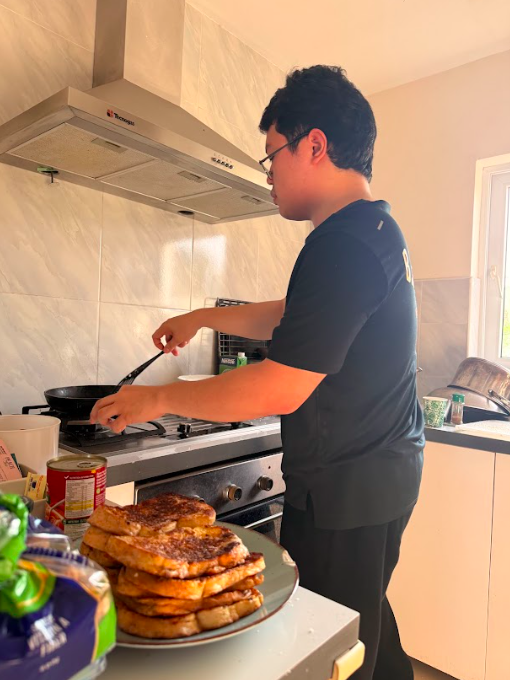
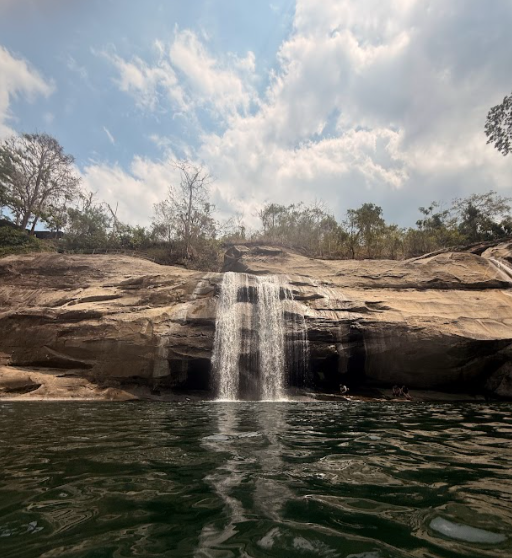
We worked from an Airbnb, shared simple meals we cooked ourselves, swum at sunrise and sunset, trekked to the glorious Tangadan Falls, explored the town on foot or by tricycle, and reminded ourselves that connection—to each other and to this planet—is our truest renewable resource.
On April 10, we held our First Friday Forum (rescheduled from Good Friday) with the theme: "When is enough, enough?" Nearly 50 people joined. We heard from Gareth Hughes of New Zealand's Wellbeing Economy Alliance and Thobile Chittenden of South Africa. We talked about Bhutan's Gross National Happiness, about the mana economy of the Māori, about the quiet revolution of "private sufficiency, public affluence."
Later that evening, we gathered for a mindfulness session—just a handful of us—and asked: What does "enough" feel like in the body? One participant said: "Light and solid, like when I walk without performing." Another said: "Enough is the capacity to love and give—that brings me peace."
We didn't solve the war. We didn't lower the price of diesel. But we remembered something essential: the same waves that challenge surfers teach us to find balance. Working from a seaside town with limited budget is not deprivation; it is intentional living. Strengthening our bonds as a team is the best preparation for whatever comes next.
SO WHAT: The Threads That Weave Us
The world as we know it is changing right before our eyes. It is overwhelming. And yet—in the same breath—it makes me feel so alive.
Anicca. Impermanence. The Buddha taught that all things arise and pass away. Christ reminds us that worrying cannot add a single hour to one’s life. War arises. Peace passes. Prices rise. Savings dwindle. Fear comes. And then, somehow, laughter erupts over breakfast. A colleague shares a French toast. Two boys chase each other squealing. And we remember that we are not separate.
Thich Nhat Hanh called it "inter-are." You cannot be without me. I cannot be without you. My breath is your breath. Your suffering is my suffering. Your joy is my joy. The war in the Middle East lands at our pumps, in our budgets, in the quiet anxiety of families wondering how to stretch the next paycheck. But it also lands in our capacity for compassion, for organizing community, for choosing to share rather than hoard.

This is what our Elyu experiment taught me: every breath is really an expression of gratitude, not fear. Every laughter becomes proof that we are present to each other. And when we intentionally step back—pause, breathe, look at the waves—we give a gift to a world in so much need of lovingkindness.
The F3 conversation about "enough" was not abstract. It was the most practical question we could ask. Because if we cannot define what is enough for ourselves, we will be endlessly seduced by the algorithms of more. If we cannot feel enough in our bodies, we will chase external validation until we collapse. If we cannot trust that together we have enough, we will hoard while others starve.
NOW WHAT: Your Own Safe-to-Fail Experiment
You don't need to drive to La Union. You don't need to install solar panels or start a garden. But you can run your own small, safe-to-fail experiment in the art of enough.
Here is a practice drawn directly from our Elyu week—adapted for anyone, anywhere, on any budget.
1. The "What Can I Control?" Audit (10 minutes)
· Sit with a notebook. Draw two columns: "Beyond My Control" (the war, the president's words, global oil prices, the weather) and "Within My Influence" (how I spend my attention, who I check on, what I eat, how I move, where I place my gratitude).
· Why: Naming what you cannot change frees you to act on what you can. This is not resignation; it is strategic surrender.
2. The "Enough in the Body" Check-In (3 minutes, daily)
· Set a timer. Close your eyes. Breathe normally. Scan your body from head to toe, asking silently: "Where do I feel tight? Where do I feel open? Where do I feel 'enough'—light, solid, at ease?" Do not judge. Just notice.
· Why: The intellect can argue about enough. The body knows. When you learn to sense sufficiency in your own flesh, you become less vulnerable to the panic of scarcity.
3. The "One Generosity" Act (daily)
· Each day, do one small thing that costs nothing but embodies enoughness: share a meal with a colleague, send a "kamusta" text, water a neighbor's plant, offer a genuine compliment, listen without interrupting.
· Why: Generosity is not about money. It is the muscle that reminds us we have enough to give. And every time we give, we prove to ourselves that we are not trapped in scarcity.
4. The "Team Pause" (once this week)
· If you work with others, propose a 15-minute check-in with no agenda. Ask: "How are we really doing? What's one small way we can lighten each other's load this week?" Do not problem-solve. Just listen.
· Why: Connection is infrastructure. Teams that pause together survive together.
5. The "Gratitude Wave" (each evening)
· Before sleep, name three things you are grateful for that you did not manufacture: a sunset, a kind word, a working tricycle, a child's laugh, a breath that came without effort.
· Why: Gratitude is not toxic positivity. It is the recognition that even in the midst of war and inflation, life is still offering gifts. Receiving them is an act of courage.
At the end of our Elyu week, we are not returning with a five-year plan. We return with tired legs, fuller hearts, maybe a nice tan, and a quiet certainty: the threads of our lives are woven by the fact that we inter-are. And when we intentionally step back, we give pause to a world in so much need of lovingkindness.
You do not need to fix the whole crisis. You only need to be present—to yourself, to your people, to the small, sacred acts of enough that ripple outward.
That is how we surf the wild waves. Not by conquering the ocean, but by learning to balance, together, one breath at a time.
Your Turn: This week, try one of the five practices above. Then share with a friend or in the comments: What did you discover about your own "enough"?